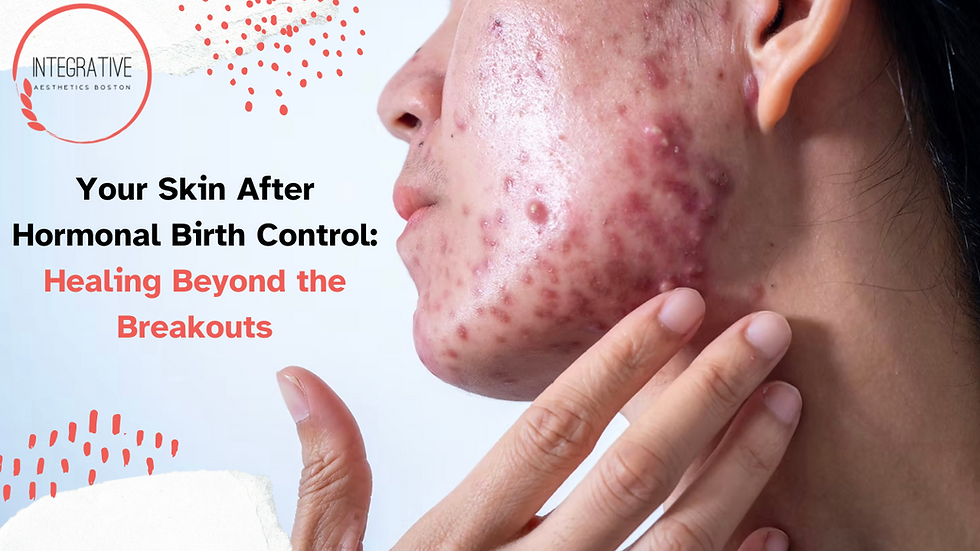
Your “Healthy” Diet May Be Making Your Skin Worse

Updated: Sep 28
You Cannot Heal Your Skin While Being Terrified of Food
I am seeing this more and more in practice. People are trying so hard to “eat clean” for their skin that they are becoming afraid to eat. They remove dairy. Then gluten. Then eggs. Then meat. Then soy. Then sugar. Then grains. Then fruit. Then nightshades. Then anything fermented. Eventually their grocery list looks less like nutrition and more like a witness-protection program.🕵️
At some point, I have to ask: What exactly are we eating? Filtered water and faith? 💧😇
Because skin, hair, hormones, immune function, and tissue repair all require raw materials. And unfortunately, collagen cannot be manufactured from anxiety and cucumber water.
Food Can Affect Skin. That Part Is Real.
Diet can absolutely influence acne, eczema, inflammation, metabolic health, and certain autoimmune and gastrointestinal conditions. That is not controversial. What is controversial is the idea that every breakout, itch, bump, or flare must be traced back to something you ate.
Sometimes food is part of the problem. Sometimes it is not. And there is a big difference between saying:
“We have identified a clear clinical reason to temporarily remove this food.”
and:
“You broke out on Wednesday, so let’s eliminate another entire food group.”
Functional dermatology should make us more curious, not more superstitious. 🧐
When Every Meal Becomes a Crime Scene
This is the cycle I often see: Someone develops acne or eczema. They remove one food. The skin does not fully improve. They remove another. Then another. Soon, they follow every meal with surveillance.
“Did that almond butter break me out?”
“Was there soybean oil in that dressing?”
“Was that tomato too high in histamine?”
“I ate bread yesterday. Did I ruin everything?”
At that point, food stops being nourishment and starts becoming a threat. That matters because your skin is not disconnected from your nervous system. Stress can affect barrier function, inflammation, immune activity, sebaceous activity, and inflammatory skin conditions.
So yes, what you eat matters.
But how you live around food matters too. If every meal comes with fear, guilt, hypervigilance, and the expectation that your skin is about to punish you, we have created another problem.
You Can Eat “Healthy” and Still Be Under-Nourished
This is especially important in highly restrictive, vegetarian and vegan diets. A well-planned vegan or vegetarian diet can be absolutely healthy for some. The problem is not veganism or vegetarianism itself. The problem is when the diet becomes repetitive, overly limited, and simply not enough food.
Now we have a math problem. Clean and adequate are not synonyms.
Plant-based diets can provide tremendous amounts of fiber, phytonutrients, folate, magnesium, and antioxidants. But depending on how the diet is structured, nutrients like iron, B12, zinc, iodine, vitamin D, calcium, omega-3 fatty acids, and protein may require more attention. Beans, nuts, and seeds are wonderful foods. They are not a complete nutritional strategy on their own. You can be eating extremely “clean” and still be depleted.
Your Hair and Skin Are Expensive Tissues
The body has priorities. Keeping your heart beating is important. Maintaining brain function is important. Keeping blood pressure stable is important.
Growing thick, luxurious hair is slightly lower on the emergency list. Hair follicles and skin cells are metabolically active tissues. They need enough energy, protein, vitamins, minerals, and essential fats to function properly. So when someone comes in exhausted, shedding hair, breaking out, eating very little, and afraid of 30 different foods, my first instinct is not always: “Great. Let’s remove chickpeas too.” Sometimes the intervention is much simpler. We need to feed this human🍲
Yes, I Do Recommend Dietary Restrictions for the Right Reasons
Let’s be very clear about this. I am not against dietary restrictions. I use them when I believe they are clinically necessary. But I do not remove foods simply because the internet has decided they are “inflammatory.” My recommendations are based on the whole clinical picture. I look at the skin or scalp condition, medical history, autoimmune history, gastrointestinal symptoms, metabolic health, dietary pattern, nutritional status, medications, symptoms, and testing when appropriate. There needs to be a clear reason.
For example, if someone has a scalp or skin condition alongside Hashimoto’s thyroiditis, celiac disease, SIBO, or another gastrointestinal, autoimmune, or metabolic condition, I do not treat the skin in isolation. I look at the whole person and consider how those conditions may influence the larger clinical picture.
A patient with confirmed celiac disease needs strict gluten avoidance because gluten avoidance is part of the medical treatment of celiac disease itself. In other cases, if someone has reproducible symptoms after gluten exposure or a broader clinical picture that makes gluten worth investigating, a temporary trial may be reasonable. That is very different from telling every person with acne that gluten is inherently bad.
Sometimes a carefully monitored temporary elimination can be useful. The point is not to label gluten as the enemy. The point is to see whether removing it actually changes symptoms in that individual, then reassess rather than assuming the restriction needs to be permanent.
The art is knowing the difference.
The recommendation has to fit that patient. The diagnosis matters. The history matters. The testing matters. The nutritional status matters. The skin matters. The whole person matters. Sometimes a restriction is medically necessary. Sometimes it is therapeutically useful for a period of time. Sometimes it is completely unnecessary.
Temporary Restriction Should Have a Purpose
There needs to be a reason. If I recommend a meaningful dietary restriction, I want that decision grounded in the clinical picture—your history, symptoms, skin or scalp condition, nutritional status, and appropriate testing when indicated. I am not interested in guessing that gluten, dairy, soy, histamine, oxalates, or some other food is the villain just because it is trending online.
When I recommend restricting a food, I want to know why. What are we trying to accomplish? What are we looking for? How long does this phase need to last?
What are we replacing that food with? Could the restriction create a nutritional deficiency?
Can we reintroduce it later? And most importantly: Is this helping the patient become healthier, or is it simply making them more afraid?
The goal is not to create the smallest diet possible. The goal is to build a more resilient body and, when medically appropriate, a broader, better-tolerated diet. Temporary restriction can be a tool. Fear should never become the treatment. Functional dermatology should not be a guessing game with your grocery list. Test, don’t guess.
Sometimes We Need to Add Before We Subtract
Healing does not always mean removing more. Sometimes we need to add. We may need more protein. More calories. More omega-3-rich foods. More minerals. More colorful plants. More carbohydrates. More dietary diversity. More consistency. More joy. More nourishing breakfast. A warm dinner with our family without Googling every ingredient on the plate.
Your nervous system needs nourishment too. Food is supposed to support life. It should not feel like a daily exam you are terrified to fail.
Functional Dermatology Should Expand the Investigation, Not Expand the Fear 🧠🔎
I believe nutrition matters, gut health can matter, hormones matter, metabolic health matters, nutrient status matters, stress physiology matters. But I also believe we get it wrong when patients leave more afraid of food than when they came in.
Fear is not a wellness plan.
The goal is to understand your body well enough that your world eventually becomes bigger, not smaller. More confidence. More flexibility. More foods you tolerate. More nutritional resilience. More trust in your body.
Less symptom surveillance. Less obsessing over every ingredient. Less believing that every bump on your forehead means you ate something wrong. Because sometimes what's standing between your skin and healing isn't one more food you need to remove.
Sometimes, you need a warm, home-cooked meal, not another list of forbidden foods.
The key is balance. 🌿⚖️
If you have been dealing with acne, eczema, hair loss, scalp concerns, or other inflammatory skin conditions and food has become a source of fear, I want you to know there is another way to approach this. You may not need another random list of foods to avoid. You may need someone to look at the whole picture. That means understanding your skin, health history, nutritional status, symptoms, lifestyle, and, when appropriate, labs.
Sometimes that means temporarily removing certain foods. Sometimes it means adding more nourishment. Sometimes it means realizing that the food you have been blaming was never the entire problem.
Not over-restricting. Not ignoring real triggers. Not eating out of fear. Not pretending nutrition does not matter. The goal is to use food strategically and thoughtfully, in a way that supports the whole person. Because healing should not make your life smaller.
It should help you feel more nourished, more confident, and more at ease in your body.
If you are ready for a more individualized approach to acne, eczema, hair loss, or other chronic skin concerns, you can book a Functional Dermatology Evaluation with me at Integrative Aesthetics Boston.
We will look beyond the surface, connect the dots, and build a plan based on your actual body, not internet fear. Your skin deserves answers. Your body deserves nourishment. And your relationship with food deserves balance.
Love & Health,🤍🌿
Functional Dermatology Practitioner
Integrative Aesthetics Boston